
The good
It’s a mix of whole or minimally-processed ingredients including nuts, seeds, wholegrains, legumes, vegetables and spices.
These are very healthy ingredients. And in fact, there’s reasonable evidence that small differences in intake (eg small serving of nuts (30g) a day) can meaningfully improve your health.
The kind of good
It’s probably a good thing that this supplement contains a mixture of different plants, but there’s nothing special about this particular mix.
Most plants and plant-sourced foods (eg oils) provide a variety of different types of nutrients and non-nutrient compounds which are beneficial.
For example, flaxseed contains the fibres cellulose, hemicellulose, lignin and some soluble fibres. However, by getting a mix of types of fibres, either from this product, or from bread, cereals, fruits, veg, nuts and seeds it will help to ensure you get a bunch of different types.
What about the spices? Despite lots of noise about spices being great for the microbiome, I can’t find (and neither can reputable academics) good evidence for their benefit. There’s one randomised controlled trial which gave a few spices and then reported a few random changes in a few of the thousands of microbes they measured. Read here for why measuring loads of outcomes is poor practice; and here for why most microbiome research is low quality.
Finally, although Zoe cite a bunch of studies showing the effect of the different ingredients on things, the individual studies used doses which are way higher than are in the Daily30+ supplement. For example, the spice study (not that it showed anything conclusive) tested 6g and 12g of spices, and I would guess a serving of Daily30+ itself has a maximum of 1g of spices in total.

The bad
It’s Zoe, so of course the bad bit is the science. (You’ll notice this is a theme).
I don’t think anyone would argue adding seeds etc onto yoghurts, cereal etc is a good thing. And everyone knows fibre is good for us and good for our microbes.
What “science” is there to do?
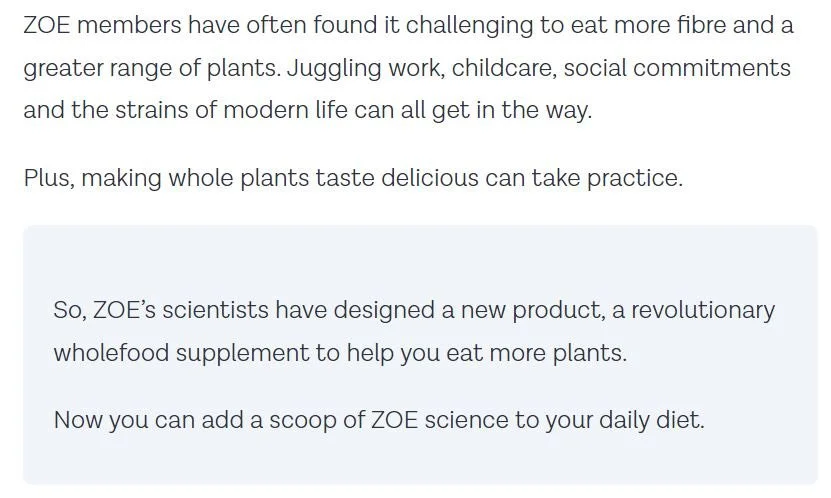
Well, as Zoe correctly state, many people can struggle to get in enough fruit, veg, wholegrains etc. So maybe it would be useful to know to what extent a supplement like this could improve a sub-optimal diet.
So how about a trial which compares a fruit and veg-poor diet supplemented with Daily30+ against a diet with 5 servings of fruit and veg? On something meaningful like blood pressure?
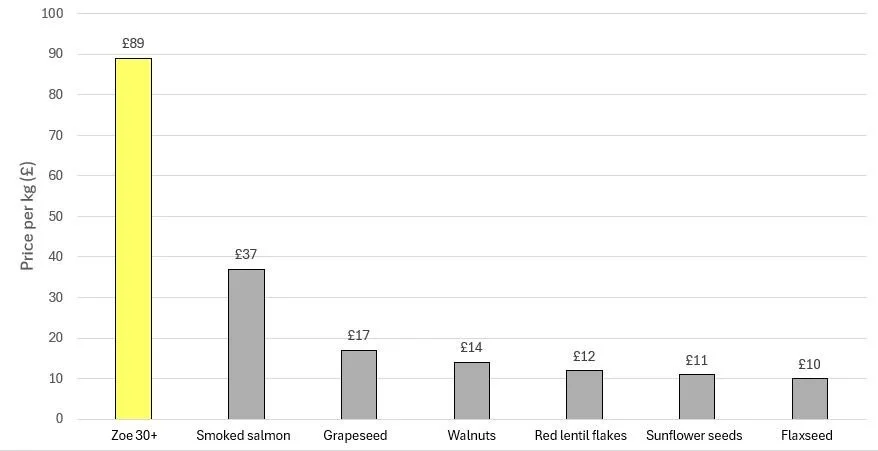
Or how about - if you’re going to charge an extortionate amount (£90/kilo) for the supplement under the guise that it’s “science-backed” - you demonstrate that it’s better than just a bog-standard bag of flaxseeds (£8-12/kilo)?
But this is Zoe.
So instead what we get is a trial comparing a bag of [high-fibre] nuts and seeds to croutons (no fibre) and a probiotic containing one strain of bacteria (no fibre) and then measuring “changes in the microbiome” as an outcome. Lol.
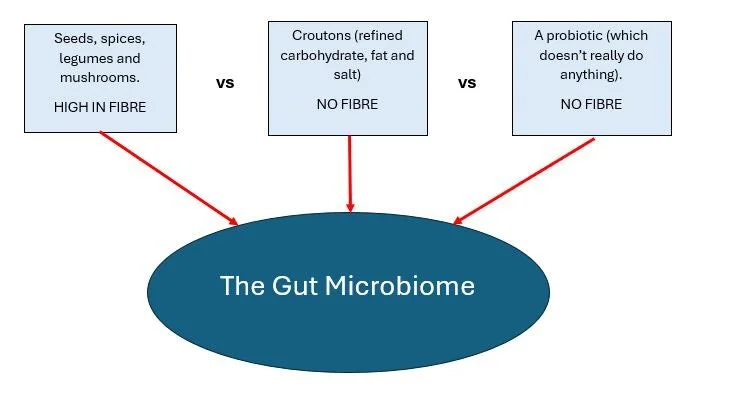
Read “Why I laugh at most microbiome trials” on why the microbiome is usually a sketchy outcome but briefly: since 1) the microbiome has zillions of species, which 2) can be grouped in zillions of ways, and 3) it changes constantly, if you don’t define specifically what changes you are looking for, you can just look at whatever changes in bacteria you get (or don’t get) and declare it “a win”.
Also: L. rhamnosus (the probiotic used as the second control in this study) might alter the amount of L. rhamnosus in the microbiome but it does surprisingly little to overall microbiome composition. (And again, you can just decide how you define “changes in the microbiome”, “microbiome composition” “relative abundance of microbiome species” etc in whatever way gets your trial that result you want anyway):
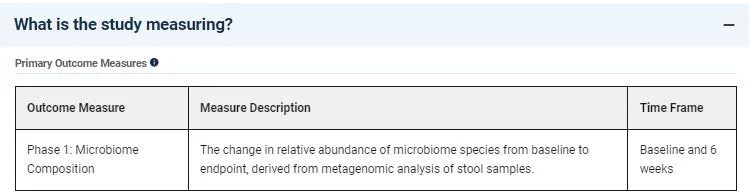
From the clinical trial registration where investigators have to say what they’re looking for before they do the study (NCT06231706 on clinicaltrials.gov):
What about the multiple other outcomes measured?
There are no changes in the cardiometabolic stuff that matters (waist circumference, cholesterol, triglycerides).
There are also improvements in gastrointestinal symptoms which isn’t a surprise with getting more fibre.
There are reported improvements in “energy” and “happiness”, but these are very subjective outcomes which are undoubtedly influenced by the fact that the group getting Daily30+ knew they were getting the fancy new supplement and thus probably just felt better as a result.
In summary, they’ve compared 10g fibre per day against no fibre per day, and chosen a primary outcome which improves with fibre and LO AND BEHOLD the supplement “worked”. *
The really bad

Even worse than the science itself is PRETENDING THEY’VE DONE SCIENCE.
Look, I’m not saying this supplement is unhealthy. It’s got a bunch of great stuff in it, but there’s no scientific innovation here. You could exchange nearly every single one** of the ingredients and switch out with another, and it wouldn’t make the slightest bit of difference.
It’s not like they’ve developed a new peptide; or a new bread product with more amylose; or proven that this particular mix is unique.
It’s a bag of seeds.
The use of words “ground-breaking”, “developed by scientists”, “tested in a clinical trial” give the veneer of science. Zoe has well and truly entered grifting territory.
If you want to spend your money on this supplement because you like the taste and it’s convenient, great. And like I said, it’s a healthy product; it’s just not special. But if you don’t want to spend you hard-earned money on a product that’s more than twice as expensive per kilo as smoked salmon, see this diet sheet for practical tips on just getting loads of plants in!
*Some trials might compare a product or food as a “swap” for a product or food typically consumed to show it can be a useful dietary exchange. But the important thing here is 1) choosing a defined primary outcome ideally which is clinically relevant, and 2) choosing a reasonable comparison, and 3) limiting your conclusions about that product taking into account what you compared it to.