
In the never ending cycle of social media trends making healthy eating probably more complicated than it needs to be, we now have “guys, you need to eat for your menstrual cycle”.
I do worry about this kind of really granular, biological approach to healthy eating. In general, a healthy diet isn't that complicated, but it can be challenging to eat in a healthy way and what mostly helps is meal preparation, and getting a decent routine down. So I do worry that complicating good nutrition with, “but on these weeks when you’re deep into the luteal phase, do things a bit differently”, isn't particularly helpful.

Do we really need to make stuff even more complicated for women on top of having to remember to pack the right size of tampons?
Does your metabolic rate change during the menstrual cycle?
There's not good evidence that it does. Some earlier studies suggested that there were minor differences between the follicular phase and the luteal phase, but the studies of that have been done more recently – with better methodology including controlling for confounding factors - have not shown that the metabolic rate is higher during the luteal phase compared to other phases. This meta-analysis goes through it in more depth if you want to read more.
Does your appetite change throughout the menstrual cycle?
I have seen on Instagram (where else?) the suggestion that because your resting metabolic rate is higher during the luteal phase (it’s probably not), that this means that hunger levels are higher.
Hunger is super hard to measure in studies because if you're asking people how hungry they are - for example using visual analogue scales - the phrasing we use to describe this (hunger/fullness etc mean different things to different people. We can measure the hunger hormones such as ghrelin, PYY and GLP-1 but this is challenging because we have many (about 60 I think) of these hormones that all feedback to the hypothalamus and we don't know what changes in only one or a couple of these hormones means. Nevertheless, most studies find no differences in the concentration of appetite hormones during the menstrual cycle.
Nevertheless, this really well done meta-analysis did find that women pretty much consistently ate more during the luteal phase of their cycle. They did a nice job of assessing the robustness of the outcome measure, only included studies where participants who were not taking the contraceptive pill, and noted how well each study controlled for confounding factors. The authors do note the studies aren't perfect because they relied on self-report of energy intake which is a source of significant error, but that their data is consistent with rodent models.
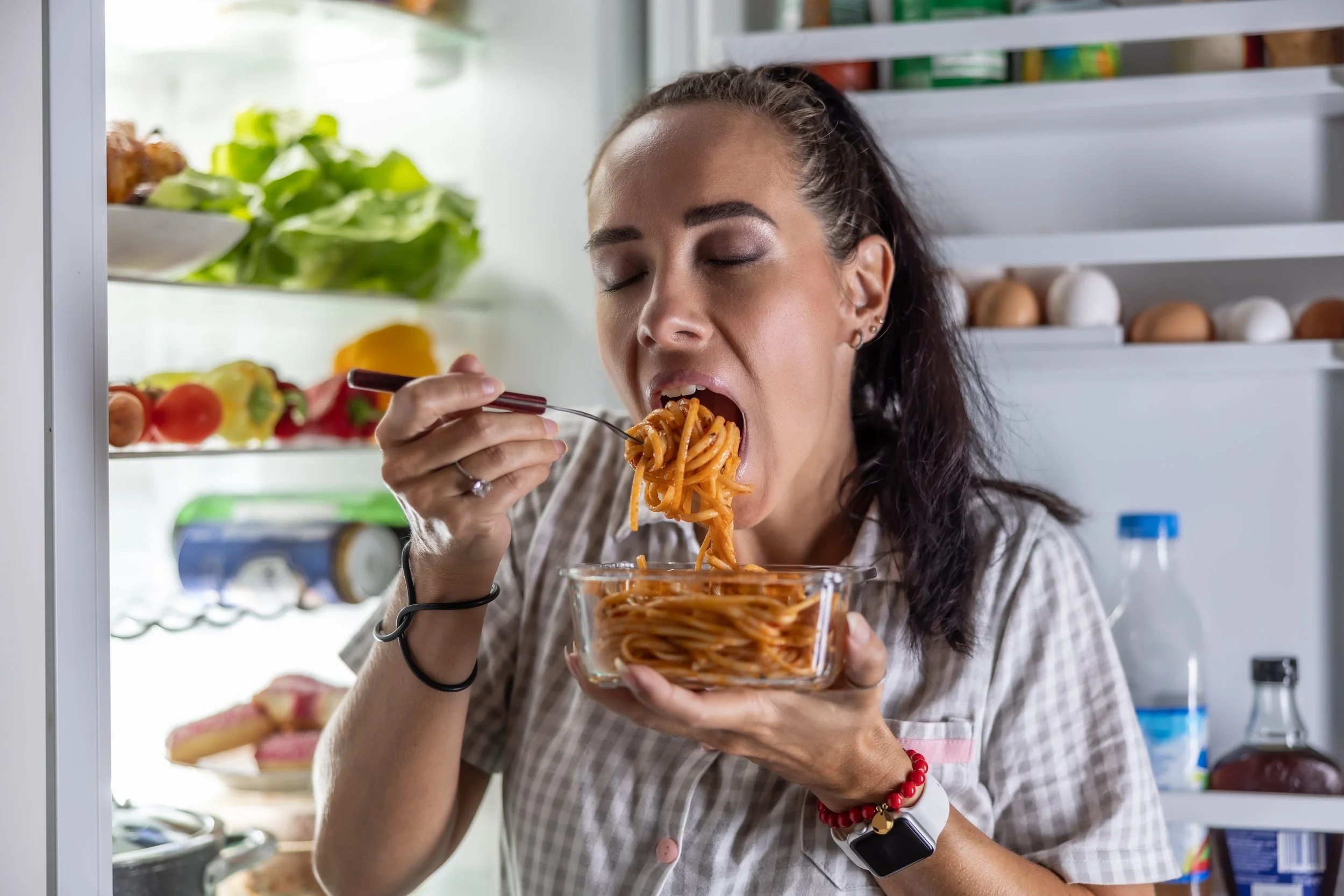
Do women's cravings differ depending on stage of the menstrual cycle?
It doesn’t look like it. Some studies find that women crave savoury things during the luteal phase, and others suggest that women crave sweet things. Studies looking at food intake over the course of the menstrual cycle also find nothing particularly consistent about what women eat during their periods, the follicular or luteal phases.
Does the menstrual phase affect gastrointestinal function?
Most women reading this or responding with “ha, ha of course it does”. There's quite a bit of research looking at gastric emptying rates and symptoms of IBS, but none of it seems particularly consistent. In other words, some people seem to get more bloating, others loose stools etc during different phases. The inconsistency might be because multiple factors have relatively larger impacts on gastric emptying and gut motility compared to hormonal fluctuations.
Summary
Once again this is another example of social media over-complicating nutrition. Eating healthily is hard enough given the food environment we live in, and I cannot imagine recommending people plan specific meals for the luteal phase based on this data. Madness.